VDI 2230 Bolted Joint Design: How to Calculate Preload and Torque for High-Stress Assemblies
A step-by-step engineering guide to VDI 2230 systematic calculation of high-duty bolted joints: compliance, load sharing, settlement factors, and torque margins.
When a critical bolted joint fails, it rarely happens because the bolt wasn't strong enough. In most cases, the failure is a direct result of improper preload. If the preload is too low, the clamped parts separate under working loads, leading to rapid fatigue failure or loosening. If the preload is too high, the bolt yields or strips during assembly.
To prevent this, mechanical engineers use the VDI 2230 standard ("Systematic calculation of high-duty bolted joints"). While the full guideline is hundreds of pages of complex equations, the core principles revolve around understanding joint elasticity, settlement losses, and load sharing.
The Joint Diagram: Understanding Elastic Deformation
A bolted joint is essentially a system of springs. When a bolt is tightened to an initial preload ($F_M$), it stretches like a tension spring. At the same time, the clamped parts compress like a compression spring.
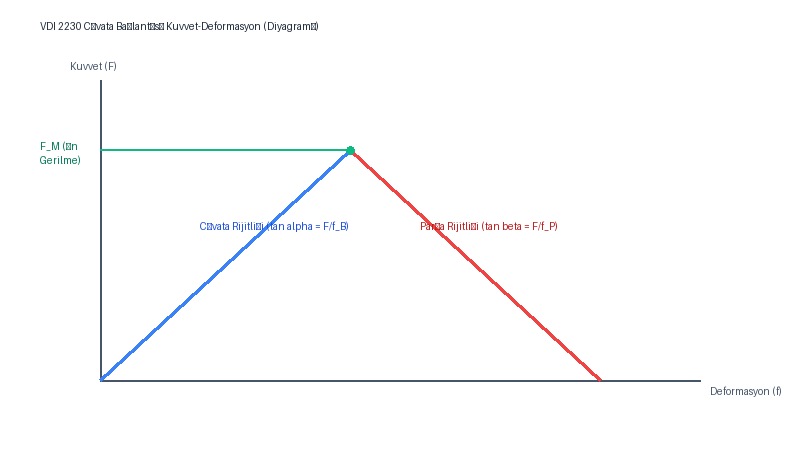
The elastic compliance (the inverse of stiffness) determines how forces are shared in the assembly. The compliance of the bolt ($\delta_B$) and the compliance of the clamped parts ($\delta_P$) are crucial parameters.
The stiffness ratio ($\Phi_k$) of the joint is defined as:
$$\Phi_k = \frac{\delta_P}{\delta_B + \delta_P}$$
Where:
- $\delta_B$: Bolt elasticity (compliance)
- $\delta_P$: Clamped parts elasticity (compliance)
When an external working load ($F_A$) is applied to the joint, it is shared between the bolt and the clamped parts. The additional force felt by the bolt ($\Delta F_B$) is only a fraction of the working load:
$$\Delta F_B = \Phi_k \cdot F_A$$
If the clamped parts are highly rigid (small $\delta_P$) and the bolt is relatively flexible (large $\delta_B$), the stiffness ratio $\Phi_k$ becomes very small. This is the ideal scenario: the rigid parts absorb most of the working load, protecting the bolt from fatigue stress.
Preload Losses due to Joint Settlement
No machined surface is perfectly flat. When the joint is assembled, the contact pressure crushes microscopic asperities on the mating threads and flange faces. This flattening is called settlement.
The loss of preload due to settlement ($\Delta F_Z$) is calculated as:
$$\Delta F_Z = \frac{f_z}{\delta_B + \delta_P}$$
Where $f_z$ is the settlement amount (typically $2 - 6\ \mu\text{m}$ depending on surface roughness and the number of mating interfaces).
Because the settlement amount $f_z$ is relatively fixed for a given surface quality, the only way to minimize the percentage of preload loss ($\Delta F_Z$) is to increase the total elastic compliance ($\delta_B + \delta_P$). This is why using a longer, more slender bolt (higher $\delta_B$) is often far more robust than using a short, stubby bolt.
The VDI 2230 Design Workflow
When systematically designing a bolted joint under VDI 2230, engineers follow these steps:
- Determine the Working Loads: Identify the maximum tensile ($F_A$) and shear ($F_Q$) loads acting on the joint during operation.
- Select Candidate Bolt Size: Pick a nominal diameter and property class (e.g., M10 Class 10.9) to estimate initial stress areas ($A_s$).
- Calculate Compliances ($\delta_B, \delta_P$): Use geometry and Young's modulus to find elastic stiffnesses.
- Evaluate Preload Losses: Compute settlement loss ($\Delta F_Z$) and thermal expansion changes.
- Verify Safety against Yielding: Ensure the maximum bolt tension under working load does not exceed $90%$ of the bolt material yield strength: $$F_{max} = F_{M,max} + \Delta F_B \leq 0.9 \cdot f_y \cdot A_s$$
- Verify Safety against Separation: Ensure that even under maximum working load, the remaining clamping force on the parts ($F_{KR}$) is positive: $$F_{KR} = F_{M,min} - (1 - \Phi_k)F_A - \Delta F_Z \geq F_{req}$$
Conclusion
Systematic bolted joint design is a balancing act of elasticities. By understanding that a bolt is a spring, you can design assemblies where the clamped parts carry the dynamic working load while the bolt remains safely preloaded. Standardizing calculations around VDI 2230 takes the guesswork out of thread selection and ensures joints perform reliably.
Sources: VDI 2230 Part 1 — Systematic Calculation of High-Duty Bolted Joints · VDI Guidelines Catalog.